
I founded a movement. By myself, which I know is the weak point of the claim, and I will come back to it.
It is called kmalloc.org, and the most important thing about it is not the server it runs on. kmalloc.org is an idea, and an idea has a property that servers do not have: once it gets into someone’s head, it is very hard to take out. You can shut down a service, ban an account, buy a company. You cannot easily unthink something. V says it in V for Vendetta, in the comic by Alan Moore and David Lloyd and again in the film: ideas are bulletproof. I do not own the mask and I am not planning anything cinematic, but I believe the line. The server is the part that can fail. The idea is the part I am betting on.
This post is the explanation: what the movement is, why I started it, and why I think this particular moment asks for it.
What it is
kmalloc.org is a small hacker space on the internet. In practice it is one server, a manifesto of seventeen points, and a set of services run with free software for people who want an alternative to the big platforms. The motto is Technology. Freedom. Dissent. The mascot is a shrike wearing a rust-coloured bandana, because every serious political project needs a bird.

The manifesto says “we” everywhere, and then admits in the preamble that today “we” means one person. I kept the plural because it is open: anyone can join by accepting the text, and anyone can propose a change to it. I am aware that a movement of one is normally called “a guy with a server”. I am fine with that as a starting point.
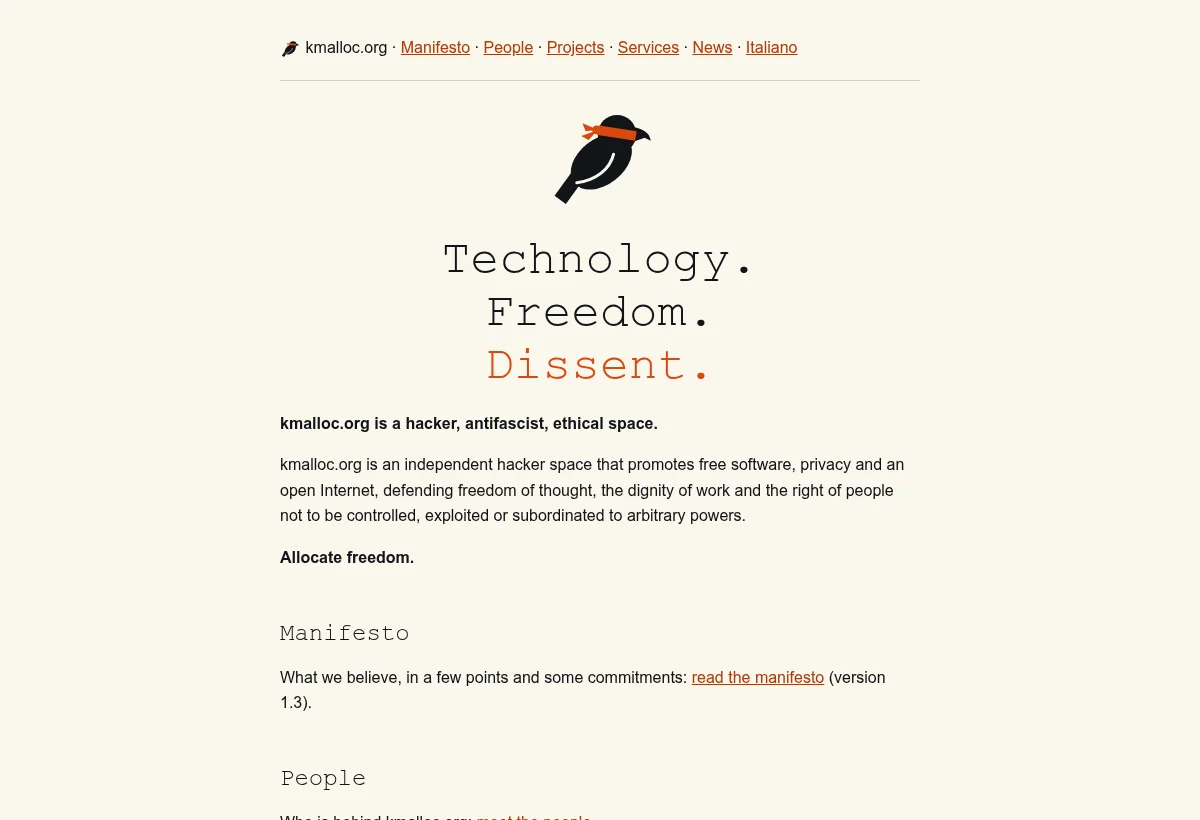
The home page. Plain HTML, no JavaScript, no cookies. The last line of the first block is the whole project in two words.
The name
The name is the nerdy part, and I will not apologise for it. kmalloc() is the function the Linux kernel uses to hand a piece of memory to whatever asks for it. If you have never read kernel code, it looks like a typo. If you have, it is an in-joke. But the joke carries a concept, and the concept is the reason I picked it.
Think about what that function does. Memory is a finite thing that a great many programs have to share, and kmalloc() does not ask who you are or what you plan to do with it. It does not profile the caller. It does not quietly hand over less than you asked for, and it does not decide you would be happier with something else. It either gives you what you requested, or it returns NULL and tells you plainly that it could not. Its twin, kfree(), is the other half of the deal: whatever you were given, you can hand back. Allocate, use, free. Nothing is held hostage.
That is the kind of infrastructure I wanted, and it is a political position written in the vocabulary of a kernel. A shared resource should be handed out without interrogation and without tricks, and you should be able to give it back and leave. The server is the allocator. You are not the product, you are the caller.
The moment we are in
Here is my reading of the times. It is an interpretation, not a study, and you are welcome to disagree with all of it.
The internet I learned on was made of protocols. Mail, the web, IRC, Usenet: rules that anyone could implement, on any machine, without asking anybody. The internet most people use today is made of places. A place has an owner, a door and a set of house rules that can change overnight. The difference sounds academic until you notice what it does to ordinary things. I can still send a message from my mail server to yours without the two of us being customers of the same company. With most of what came after mail, that sentence is no longer true.
Then there is the renting. Over the years, a large part of what used to be bought became a subscription. The software you work with is rented by the month. The music, the films and many of the books are licences that last as long as the account does. Your own photos and documents sit in a storage plan, which means you are renting access to your own data. I do not think any single one of these is a scandal. Renting is often convenient, and I pay a monthly bill for the kmalloc.org server like everybody else. The problem is the sum. When everything in your digital life is on a lease, the terms can change after you have moved in, and leaving means abandoning what you built there. The manifesto has a line for this that I like more than most of the others: if you cannot leave, you are not truly free to choose.
The third piece is the business model. A lot of what is free to use is paid for by watching the people who use it: collecting, profiling, selling attention. I want to be careful here, and the manifesto is careful too. It does not claim that every use of data by every large company is unlawful. What it rejects is the idea that commercial surveillance is inevitable, the price of admission to digital life. I have run services without it for years. It is possible. It is just not as profitable.
And now the newest layer, which is AI. I am not against it. I use it, the manifesto says so openly, and it has two whole points about how to use it without turning into its appendix. But the models were built on what people had published in the open, and nobody asked me. That is one of the reasons I moved my repositories off GitHub some time ago. The lesson I took from it is simple and a little bleak: whatever sits in a big enough pile will be used by whoever owns the pile, for purposes that did not exist when you put it there. Being angry at the tool gets you nowhere. Keeping your things out of other people’s piles is a plan.
Put these together and you get what I would call an enclosure. The common ground did not disappear. It got fenced, a piece at a time, each fence reasonable when taken alone. A handful of companies now sit between most people and their mail, their conversations, their code, their memories and, increasingly, their thinking. That is a lot of power in very few hands, and power that concentrated can be leaned on. I do not need to imagine a villain. I only need to imagine an ordinary company on a bad quarter, or under pressure from a government having a bad decade, and ask what happens to the people who depend on it. My honest impression is that the political weather is getting worse for dissent, not better, and I would rather not discover how a few platforms behave when it turns.
The strange part of this moment is that nothing is actually lost yet. The protocols still work. The software to run them is free, documented and better than it has ever been. What changed is the default: being independent used to be how the network worked, and now it is something you have to choose and then maintain. That is the gap kmalloc.org is trying to stand in.
Why not just a better platform
The obvious answer to a bad platform is a good one: same shape, kinder owner. I do not believe in it, and the reason is not cynicism about owners. A good platform is still a single point where everything depends on the owner staying good, staying solvent and staying in charge. That includes me. I would not trust a version of the internet that only works as long as I remain a decent person with free evenings.
So the answer has to be structural, and it is an old one: federation. An account on our Mastodon talks to people on thousands of other servers. The same is true for Matrix, for XMPP and of course for mail. If I turn out to be a bad administrator, you take your address book elsewhere and keep talking to the same people. The commitments at the end of the manifesto exist for this: a public table of what the administrator can see and how long data is kept, a written reason and an appeal for every refused or closed account, ninety days of notice and a data export if the whole thing shuts down. Making it possible to leave is the feature.
It also has to be small. Accounts on kmalloc.org are created by hand, by me, for people who share the principles and respect the rules of use. That does not scale, which is the point. A server where the administrator knows roughly who is on it does not need a moderation department or a recommendation engine. If it gets too big, the right move is a second server run by somebody else.
And it has to be boring. Most of what runs there is old, dull, well understood software. Mailing lists. A git forge. A chat protocol older than some of the people who would use it. I trust boring infrastructure for the same reason I trust a hammer: there is no roadmap in it. The manifesto says that an alternative nobody can use is not enough, and I agree, so the boring things have webmail and web clients and a status page.
In fairness, the limits are real and the site states them. Everything is run by one person on one server, with nightly encrypted backups and no guarantee of availability. The status page runs on the same machine as the services, so if the server dies the page that would tell you dies with it. A silent status page is also information.
What dissent means here
“Dissent” is the word in the motto that makes people nervous, so let me defuse it.
It does not mean being against technology. I write software for a living and for fun, and the manifesto is openly in favour of AI used as a tool. It does not mean being against business either: there is a point that says profit is not a sin and that we oppose monopolies, not enterprise. And it is not a pose. The only one at kmalloc.org dressed for a riot is the bird.
What it means is narrower and more stubborn: the right to say no and still take part. No to the tracker, and still read the page. No to the mandatory account with a large company, and still collaborate on the code. On one subject the manifesto does not hedge at all: it is antifascist, with no ambiguity, and independence is not an excuse for neutrality in front of oppression.
Dissent also points inwards. The text says we are not looking for followers, and that no idea is beyond discussion, the manifesto included. It has changed three times in its first four days, which tells you how settled I think it is. The version history is public, and so is the place to argue with it.
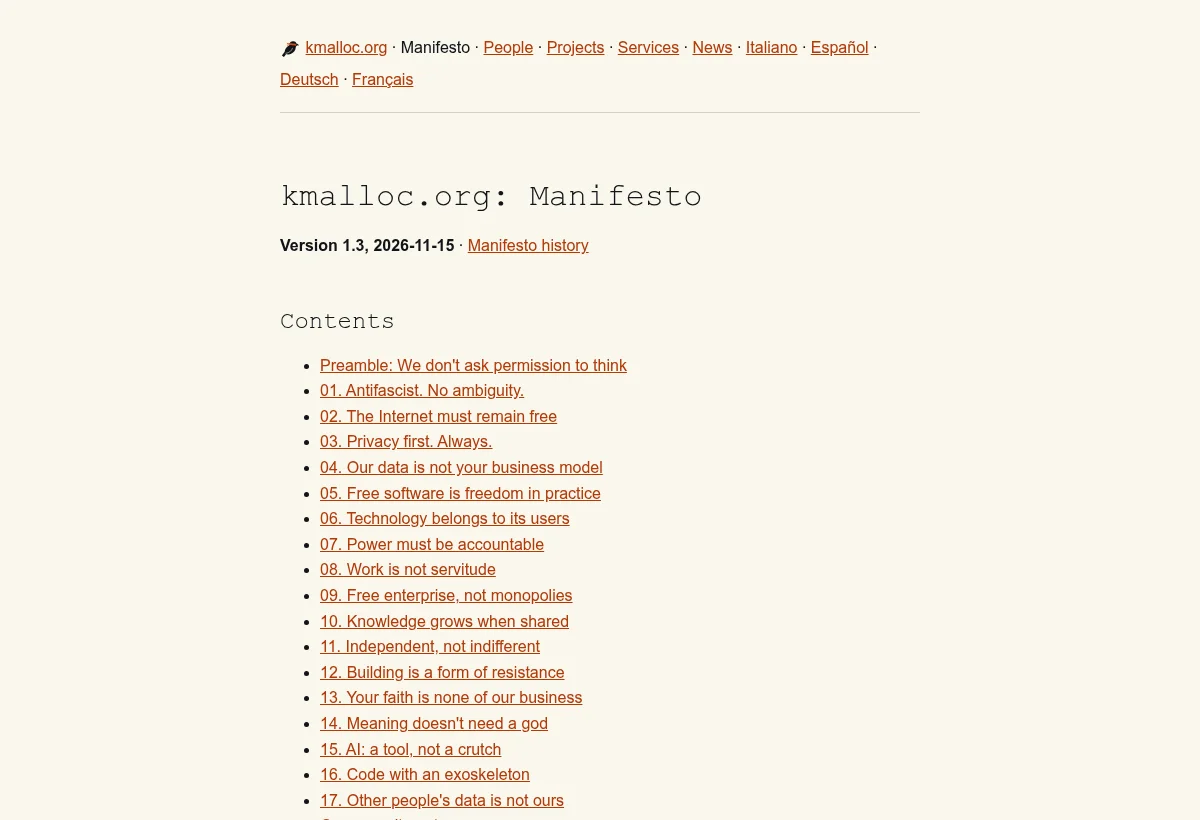
The manifesto, version 1.3. The history is one click from the title.
Point 12 of the manifesto is the one I try to live by: build, don’t just complain. Complaining about the state of the internet is easy and I am quite good at it. Keeping a mail server patched is the less glamorous half.
What actually runs
So that this does not stay a theory, here is what exists today. A Forgejo instance at git.kmalloc.org, where all the project’s code lives. A Mastodon server, with accounts on approval. A Matrix homeserver with Element, and XMPP with a web client. Mailing lists on Mailman, mail with webmail, video calls on Jitsi. BookWyrm at lore.kmalloc.org for people who read, and WriteFreely blogs at log.kmalloc.org for people who write.
The site itself is built by motorino, a static site generator I wrote for it: Markdown in, plain HTML out, no JavaScript. It sets no cookies and logs no visits. Next to it there are two younger projects, both early. Sonda is a music server that plays the files you already own and keeps what it learns about your listening on your own machine. Parsimony is a mailing list manager in a single binary, because I have now administered Mailman and have opinions.
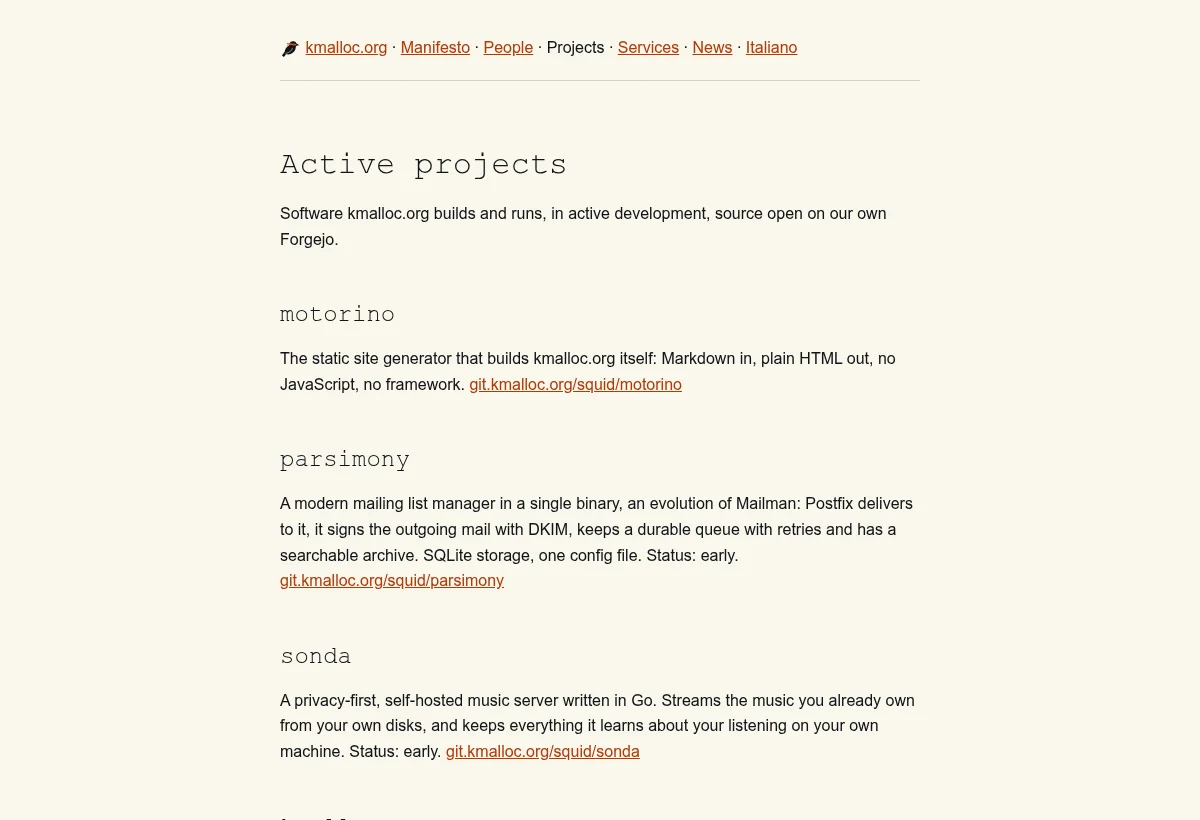
The projects page. The code is on our own forge, not on someone else’s.
The whole thing costs EUR 37.50 a month. I pay for it. Donations and the small merchandise shop help, and neither buys a say in any decision.
If you want in, or want your own
The services are free of charge. You ask for an account through the request form on the site, or by writing to me with GPG. Yes, encrypted mail as the front door. I know what that does to the size of the crowd.
The better option, though, is that you do not need me at all. Everything I run is free software that you can install on a small machine of your own. The manifesto is under CC BY-SA 4.0: take it, change the parts you disagree with, publish your version. Run a server for your family, your band, your association, five friends. Federation means that your small server and mine are part of the same network on day one, with nobody in the middle to approve it.
If you do neither and only read the manifesto and argue with it in a public issue, that is a contribution too. Probably the most useful one right now.
One server
I do not know what kmalloc.org becomes. It may stay one person and one machine for a long time, a slightly overbuilt way of having an email address. It may turn into a handful of people who keep each other’s services alive. I have no growth plan and I would be suspicious of myself if I had one.
What I know is smaller. Not long ago I thought the sensible thing was to pick good providers and stop there, and I still think that is a perfectly respectable choice. But somewhere between the third subscription renewal and the fourth terms-of-service update I wanted one corner of the network where I could read every rule, because I wrote them, and where anyone who dislikes them can leave with their data.
So I allocated one. It either works, or it tells you plainly that it could not.