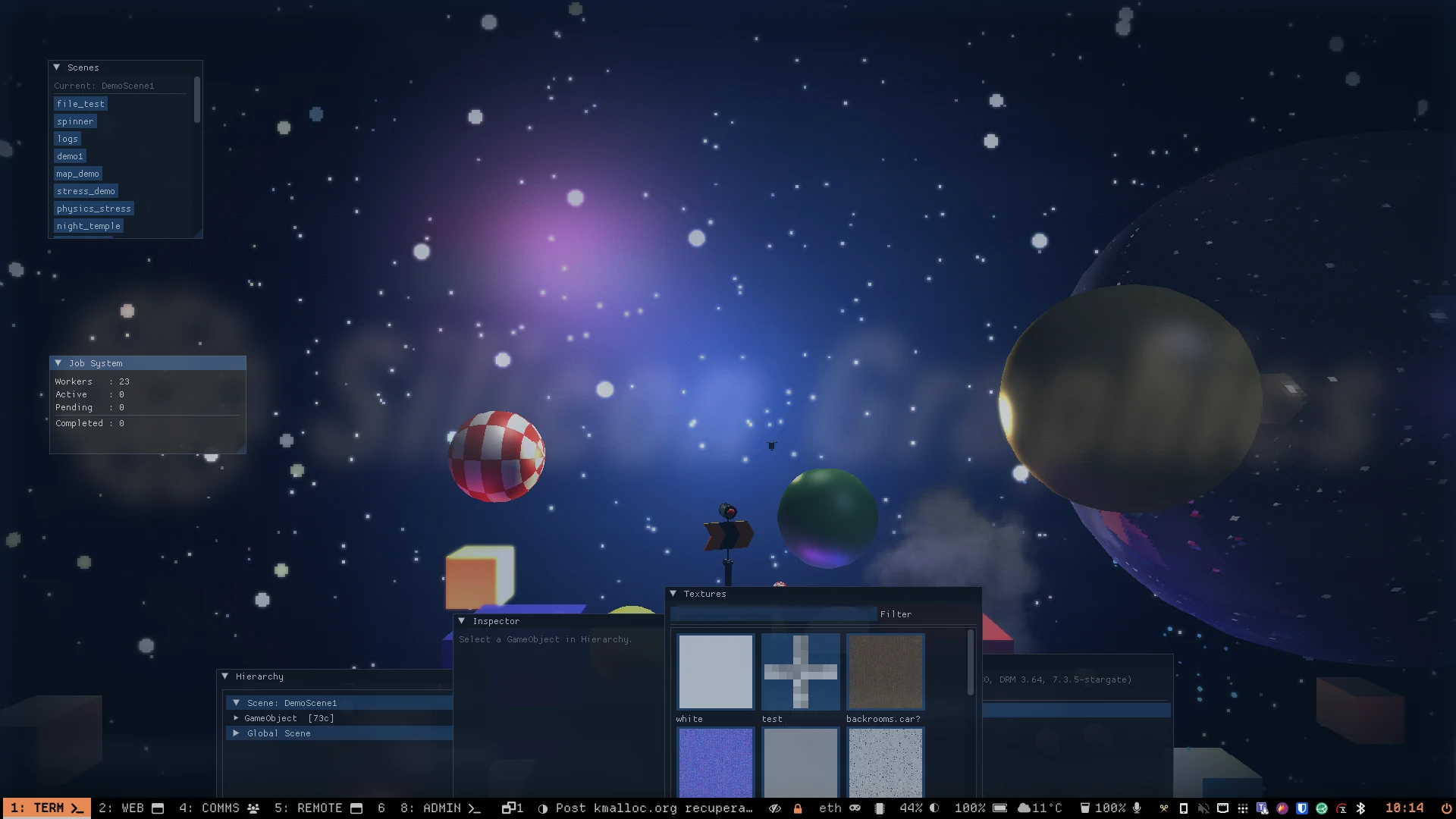
A week after the first commit, LyLy has stopped being a window with a triangle in it. It has a scene graph, a component system, a job scheduler, a deferred renderer, and enough in-engine tooling (shown above, running live over the demo scene) to inspect all of it without attaching a debugger. None of this came in the order I expected.
GameObjects before Components
The obvious move for an engine like this is “design the Component system first.” I didn’t. Transform and Scene showed up on day two, with a working parent/child hierarchy, recursive update, and a render pipeline already drawing a GameObject tree, three full days before Component existed as an abstract class at all. The early objects just did things themselves.
Component arrived once I had enough real objects in the demo scene to see what actually needed to vary per-object instead of living on the base type: attach, a one-time start, update, late-update, detach, and a registry so a query like “every Light in this scene” doesn’t walk the whole tree by hand. Building the general abstraction after the concrete need, instead of before it, meant the component API only has the hooks the engine actually uses.
Dependency injection and an event bus, from the first day
Two architectural decisions predate the renderer entirely, DryIoc for composition and an EventBus for anything that needs to react to something without holding a reference to it. Both were wired in on commit one, before there was a window to show. LyLy.Engine ties together systems that have no business knowing about each other directly (audio, UI, physics, scripting, the asset pipeline), and the alternative to DI and pub/sub here is a web of constructor parameters that grows with every new system. EventBus stays deliberately simple: type-exact, synchronous, subscribe/publish/unsubscribe-by-token. It is not trying to be a message queue.
A job system for the work that shouldn’t block a frame
JobSystem landed on day six: a small worker pool with a Task-based API, running on background threads so the main thread never stalls waiting for something like a generated room layout. The Job System panel in the screenshot is reporting on that same system, 23 workers, idle at the moment that shot was taken. This is also the system that, a few days later, let me add a procedural dungeon scene that streams rooms in as jobs instead of generating the whole level up front.
The deferred pipeline
The renderer’s big structural decision, deferred shading for opaque materials, landed in one long day: a G-buffer pass that writes position/normal/material data, then a full-screen deferred lighting pass that reads it back and does the actual shading math once per pixel instead of once per light per object. Bloom came out of the same day’s work, which is why bloom masking is baked into the material system instead of bolted on afterward. A material can flag itself as a bloom source, and the G-buffer pass writes that flag straight into the alpha channel it would otherwise discard.
The same day also shipped two things that aren’t about pixels at all: Lua scripting (so behaviour doesn’t always require a recompile) and .scene.toml, a declarative scene file format parsed into the same Scene/GameObject graph that C# code builds directly. A scene can be authored either way, and the engine doesn’t know the difference once it’s loaded.
An editor, because typing coordinates gets old fast
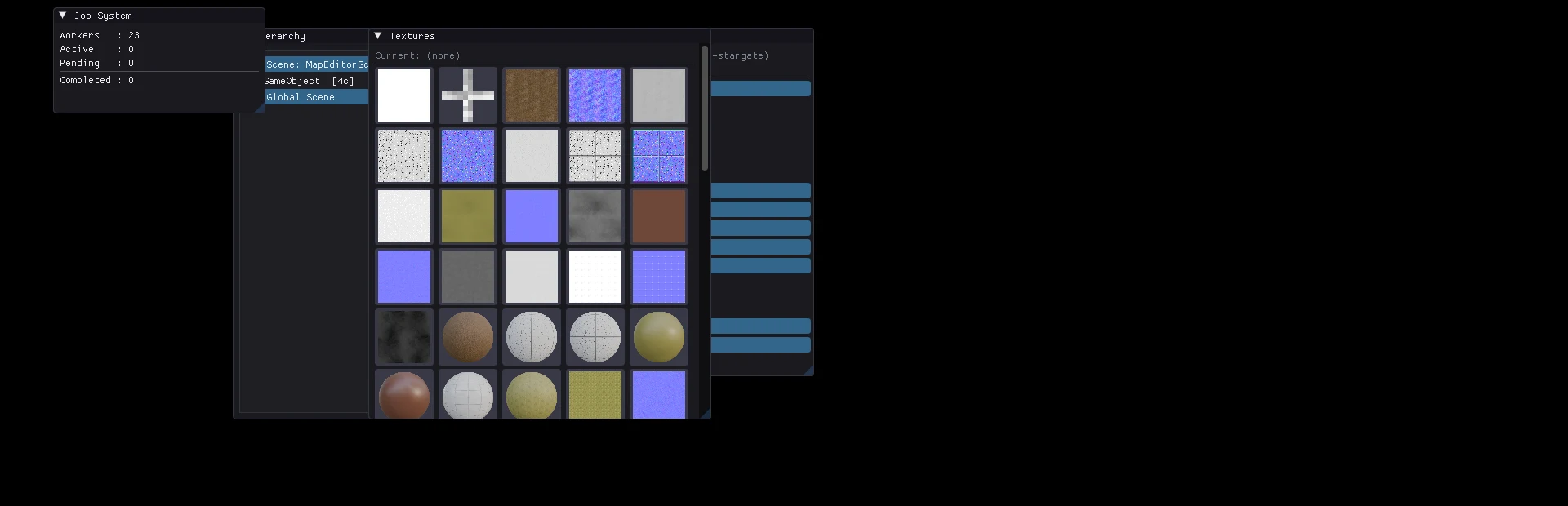
The map editor is not a separate application. It’s a scene like any other, built out of the same ImGui integration the debug overlays use, with a canvas, sector/thing placement tools, snap-to-grid, and a texture palette (visible above). It writes the same .scene.toml-adjacent map format the engine already knows how to load, so there’s exactly one code path between “I drew this in the editor” and “the game loads this room.”
Up next: the part of the project that sat untouched for three and a half months after this, then shipped in five days. Portals.