When I was ten years old my parents gave me my first computer: an IBM PS/2 with a glorious 486DX.
I don’t have a long list of memories from that machine. I have one that is very clear: playing Gorilla with my dad. Two gorillas on top of a city, one banana at a time.
It felt like pure magic. That is the moment my passion for computers started, and I can point at it.
What Gorilla actually was
The game is officially called Gorillas. Most people know it by its file name, GORILLA.BAS. It was one of the sample programs that came with QBasic, and QBasic came with MS-DOS starting from version 5, as the replacement for the older GW-BASIC. The other samples were Nibbles (a snake game), a money manager and a small utility to strip line numbers from old BASIC programs.
So nobody bought Gorilla. If you had DOS, you had it, sitting in a directory next to the system files.
The rules fit in a paragraph. The program draws a random skyline and puts a gorilla on a roof at each side. You type your names, how many points to play to, and the gravity. Then you take turns typing two numbers: an angle and a velocity. The banana flies, the wind pushes it, and it either blows a hole in a building or hits the other gorilla. Whoever gets hit loses the round.
There is no computer opponent. It is a game for two people at one keyboard, which is exactly how I remember it.
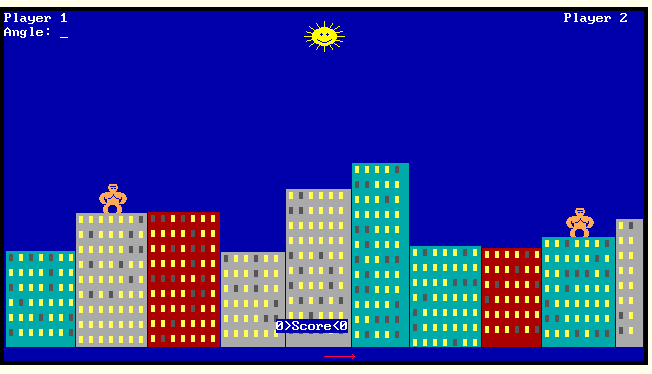
Gorillas, the QBasic sample game. Two numbers per turn: angle and velocity.
The source was the game
GORILLA.BAS is a program listing. A text file. There was no separate, closed executable with the “real” game inside. To play, you opened the file in QBasic and ran it, and the code was on screen before the gorillas were.
The first lines of the file are a comment addressed to whoever is reading:
' Your mission is to hit your opponent with the exploding banana
' by varying the angle and power of your throw, taking into account
' wind speed, gravity, and the city skyline.
A few lines below, the same comment tells you that if the game runs too slow or too fast on your machine, you should go and change the CONST SPEEDCONST = 500 line yourself. The larger the number, the faster the game. The fix for a performance problem was “edit the source”, written by the people who shipped it.
The whole flight of the banana is two lines:
x# = StartXPos + (InitXVel# * t#) + (.5 * (Wind / 5) * t# ^ 2)
y# = StartYPos + ((-1 * (InitYVel# * t#)) + (.5 * gravity# * t# ^ 2)) * (ScrHeight / 350)
That is the projectile formula from a school physics book, with the wind added as a sideways acceleration. The gravity question at the start is real too: the prompt says Gravity in Meters/Sec (Earth = 9.8), and if you just press Enter you get 9.8. Type a smaller number and the bananas float.
The sun in the sky has two faces: a happy one, and a shocked one for when a banana flies through it. The code calls them SUNHAPPY and SUNSHOCK. I like that somebody took the time.
Why this was the right first game for me
I have always been the kind of person who needs to understand how things work. Take them apart, study them, rebuild them.
Most games of that time were sealed boxes. You could play them, and that was the whole relationship. Gorilla had no lid. The thing that made the banana fly was a few screens down, in plain English keywords, and the same editor that showed it to you would let you change it and press run again.
Even the DOS text editor was part of this. In those versions of MS-DOS, the EDIT command was QBasic itself, started in an editor-only mode. The tool to open things up was installed on every machine, whether the owner knew it or not.
What I don’t remember
I don’t remember which version of DOS was on that PS/2. I don’t remember how I found the game, or who showed it to whom. I can’t tell you that at ten I read the source and understood it, because I don’t know when I first looked at the code instead of the gorillas.
What I remember is the game, playing it with my dad, and the feeling that the machine could do things I could not explain. The explaining came later, slowly, and it has not stopped.
Small enough to read
Retro computing is one of my passions now: the machines that started it all. Part of the reason is in this file.
GORILLA.BAS is about a thousand lines of BASIC, comments included, split into a little more than twenty small routines with names like MakeCityScape, PlaceGorillas, DoExplosion and VictoryDance. You can read it in one sitting, and at the end you know how the entire game works: the skyline, the throw, the explosion, the score.
Very little software I use today can be read in one sitting. This one can. It came free with the operating system, and I played it with my dad.