I have always been a hardcore Linux user. The first Linux I ever touched came from a store.
It was called Caldera Linux. My dad took me to the local computer store, Essedi Shop, to buy it. I was about 14. The year was 1999, maybe 2000. The computer was a Pentium II, if I’m remembering correctly.
Essedi Shop deserves a post of its own, so I will leave it there for now.
What Caldera was, and what I got wrong
In my head, Caldera was “somehow related to SUSE”. I was not sure and I never checked. I finally did, and it was not.
Caldera was an American company from Utah, founded in 1994 by Bryan Sparks and Ransom Love, two former Novell employees. Its distribution, OpenLinux, was built on LST Power Linux, the work of a German group called Linux Support Team, which Caldera bought and turned into its development center in Erlangen. In 1998 the Linux business was spun off as Caldera Systems.
SuSE was a competitor. The two only ended up on the same side in 2002, in a consortium called UnitedLinux, whose distribution was based mostly on SuSE’s enterprise product. My guess is that my memory glued together “German roots” and “UnitedLinux” and filed the result under SUSE. I can’t prove that.
About the screenshots
The four images in this post were taken years later, not in 1999. I installed Caldera OpenLinux 2.3 from its CD image into an emulator, QEMU, and booted it. They show what the system looked like. They are not my screen from back then. One more detail: on the first login KDE drew garbled text until I switched off graphics acceleration in the X server configuration.
I also don’t remember which version I bought. OpenLinux 2.2 came out in April 1999 and 2.3 in September of the same year, so it was probably one of those two. I picked 2.3 for the emulator and I can’t tell you it is the right one.
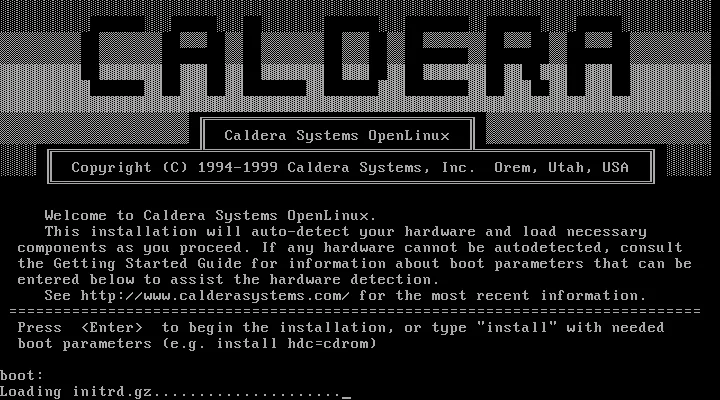
The boot screen of the OpenLinux 2.3 install CD, in QEMU.
Lizard
The installer was called Lizard, short for Linux Wizard. Caldera’s German team started working on it in November 1998, and it is usually described as the first fully graphical installer for Linux. You booted from the CD and got a mouse pointer and a set of screens to click through.
Reviews from 1999 say it even offered a game of Tetris while the packages were being copied. Salon called OpenLinux 2.2 the easiest installation of any Linux distribution so far. Linux Journal gave 2.3 a Product of the Year award and named the installer as a reason.
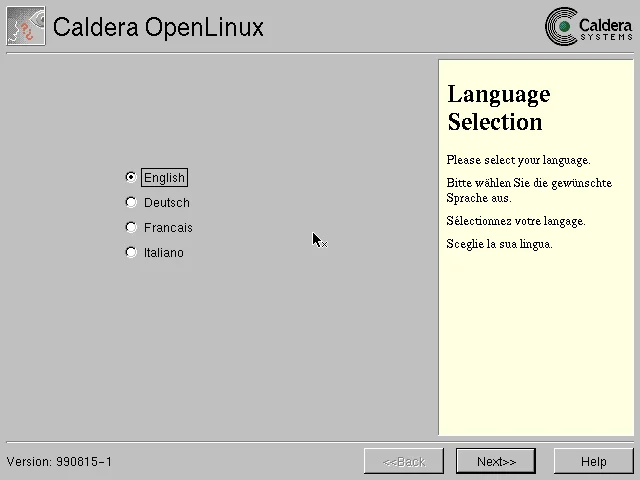
Lizard, first page: language selection, with Italian on the list. Version 990815-1, in QEMU.
So I was holding what the press considered the friendliest Linux on the market. Here is what I did with it.
I erased Windows every time
I had no idea how to set up dual boot. So every time I wanted to try Linux, I erased Windows entirely and installed Linux.
Reading about it now makes this worse. The sources I found say the OpenLinux 2.2 installation could be started from inside Windows, and that it would shrink the Windows partition to make room for Linux. If I had one of those versions, the solution to my problem was already in what I had bought. I didn’t know. The disk got wiped.
Once it was installed, it was almost unusable. The fault was mine: I didn’t know anything. And it was 1999, after all.
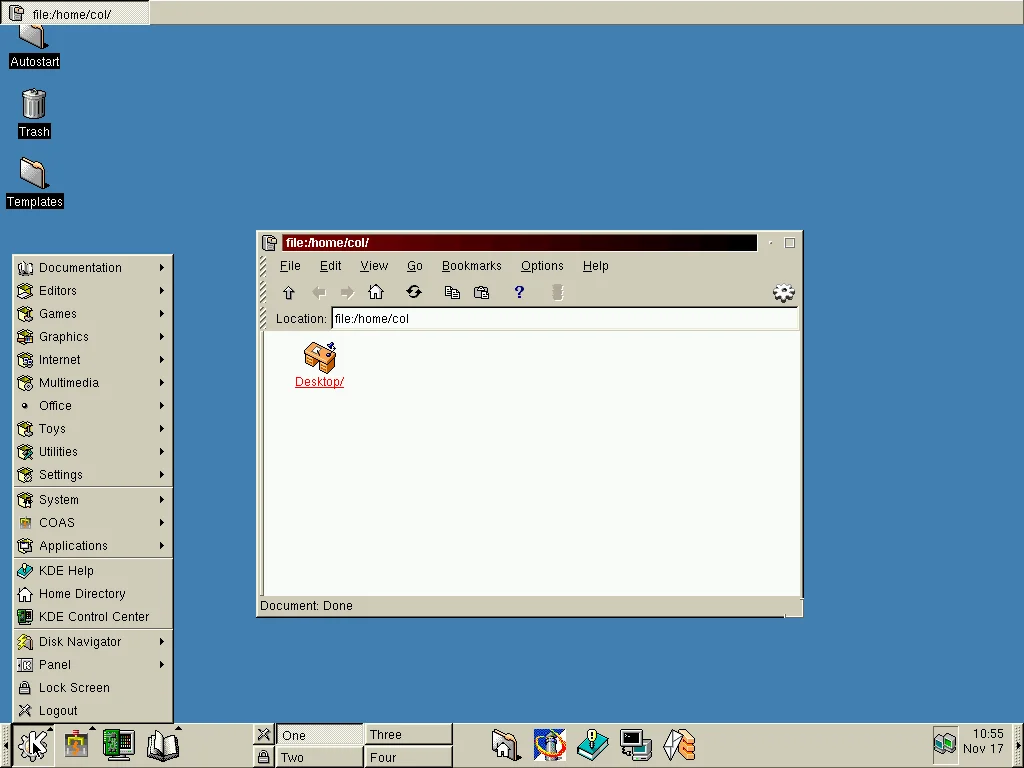
KDE 1.1 on OpenLinux 2.3, with the K menu open, in QEMU.
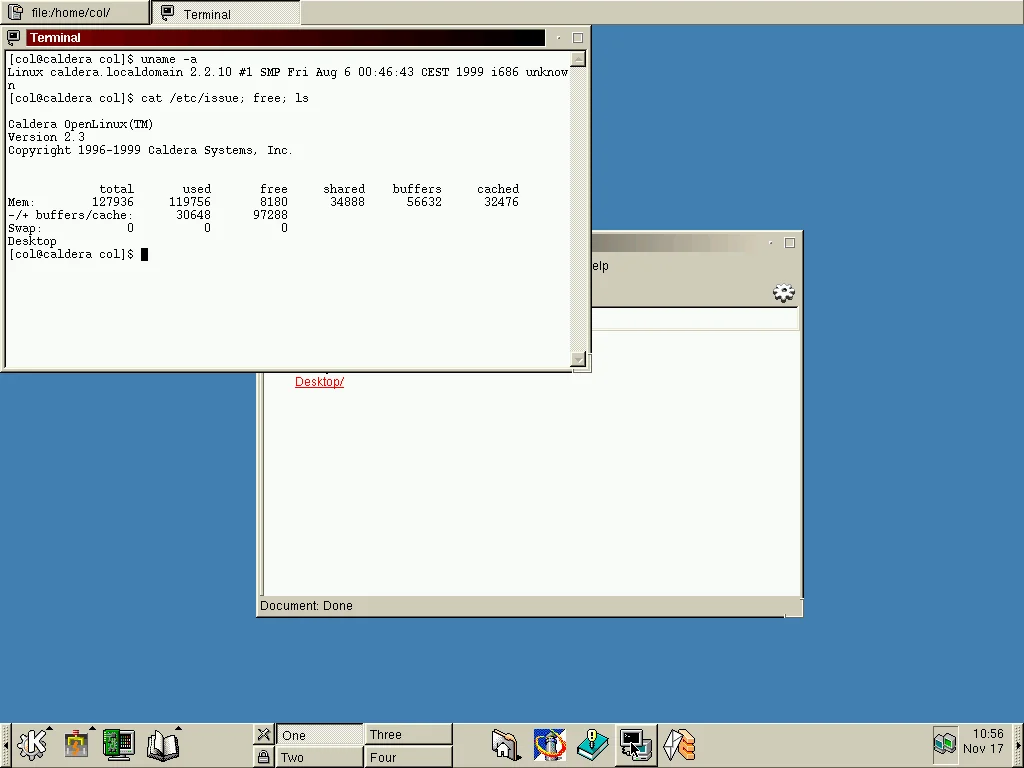
A terminal on the same system. uname -a says Linux 2.2.10, built in August 1999.
OpenLinux used KDE as its desktop, so there was a panel, a menu and windows. Everything was there. I just didn’t know what to do with it.
Feeling like a hacker
I loved it anyway.
Using Linux made me feel like a hacker. Like I could get inside systems and mess around with all the cool stuff. I was fascinated right from the start, long before I was any good at it. I used it for a while, and I loved it.
Linux was a whole operating system I could open up and poke at. I still do that.
What happened to Caldera
Caldera doesn’t exist anymore, and the way it ended is not a nice story.
In August 2000 Caldera Systems announced it was buying the Unix business of the Santa Cruz Operation. The deal closed in May 2001 and the company became Caldera International. The last OpenLinux release, 3.1.1, came out in January 2002. A few months later there was a new CEO, and in August 2002 the company announced that it would rename itself The SCO Group.
In March 2003 SCO sued IBM for at least a billion dollars, claiming that Unix code had ended up in Linux, and it stopped selling its own Linux. It sent letters to about 1,500 companies warning them about using Linux. In 2007 a court rejected SCO’s claim to the Unix copyrights, the company filed for bankruptcy, and the last piece of the IBM case was settled in 2021 for a tiny fraction of the original number.
So the company that sold me my first Linux spent its final years suing people over Linux. None of that had happened yet when I was 14. I only knew the name.
Still here
More than twenty five years later I am still a Linux user. I don’t have a dual boot any more, because I don’t have Windows any more.
The memory I keep from that time is small: a trip to a store with my dad, a Pentium II, and a disk I kept wiping because I didn’t know better. It was enough to start.